Since Lawcover Insurance began trading in 2004, a NSW solicitor who practises only in the state has had one place to buy the compulsory professional indemnity cover needed to hold a practising certificate. On Friday, parliament started asking whether that should change.
A Legislative Council select committee was set up on 5 August to examine competition in solicitors' PI insurance. On Friday, at its only public hearing, ABC Insurance, the company trying to break in, made its case against Lawcover and its parent, the Law Society of NSW. Officials from the state's justice department also appeared.
The market is worth fighting over. NSW had 45,208 practising solicitors at 30 June, and Lawcover covers about 80% of them, according to an actuarial report by Deloitte commissioned by the state government. The rest mostly work at practices with interstate offices, which can buy cover elsewhere. Small firms have no such option. Of the state's 7,388 private law practices, 64% are run by a single solicitor.
ABC is an underwriting agency backed by Liberty Mutual through Liberty Specialty Markets. It has been trying to get into this market since late 2022. Its plan to launch for the 2024-25 year stalled when the NSW Court of Appeal ruled in April 2024 that the Attorney-General had the power to approve both the policy and the insurer. The company was later ordered to pay the Law Society's legal costs as well.
Read next: ABC Insurance loses bid to dodge legal costs in PII dispute
The timing of the Attorney-General's decisions is part of ABC's complaint. According to his answers to Budget Estimates questions, Michael Daley approved Lawcover's policies for 2025-26 on 25 February 2025 but did not refuse ABC's until 10 July 2025. For 2026-27 he approved Lawcover's policies on 26 February 2026. ABC's application for that year was also refused, and ABC has asked for an urgent review.
ABC director David Sandig told the committee the problem is structural: a Law Society that both regulates solicitors and owns the company insuring them has a conflict built in. He argued that departmental documents released to parliament showed ABC's application had been approached with a closed mind.
Sandig also argued that competition would make the market more stable, because a market with several insurers can absorb one of them failing. NSW has seen what happens when a single insurer fails.
HIH was the profession's approved insurer from 1998 to 2001, and its collapse prompted parliament to pass legislation so the solicitors' indemnity fund could meet HIH's obligations. Daley has drawn the opposite lesson from the same history, citing HIH at Budget Estimates this year as a reason to put stability first.
ABC's backer has its own history in this market. The Deloitte report notes that the ACT had more than one solicitors' PI provider until 2021. That year Gallagher, underwritten by Liberty, withdrew shortly before renewal, and Lawcover picked up most of its practices.
Lawcover's supporters argue that a competitor would make the market less stable, not more. Committee member Bob Nava, a Labor MLC, raised the classic adverse selection problem. A profit-driven rival could skim off the lowest-risk practices, pushing up costs, and premiums, for the firms left with Lawcover.
ABC has said its premiums would have been 35% to 45% lower on average. Peter Candotti, Lawcover's finance chief, questioned how discounts that deep could coexist with covering every firm. In his view ABC would have to either pay out less on claims or insure only the better risks, and he argued either outcome would hurt solicitors.
The Deloitte report supports parts of both arguments. It modelled that a newcomer would probably need to price at least 10% below Lawcover to win business, and that average premiums would likely rise modestly over the longer term. But it also found Lawcover's administration costs are higher than those of Victoria's statutory insurer. It estimated that an average commercial PI provider could run about 35% more efficiently.
Read next: Court hits Lawcover with $510k judgment over solicitor's estate planning error
Kenneth Tickle, the Law Society's chief executive, rejected the conflict claim, describing Lawcover as financially separate from its parent and retaining its own surpluses. His sharper point was that competition would create a conflict rather than remove one. A Lawcover forced to compete might have to turn away riskier firms, leaving the regulator's own subsidiary effectively shutting solicitors out of practice. He also noted that sole-provider schemes are the norm in Australia, which the Deloitte report confirms.
The money question is less clear-cut than it first appears. At Budget Estimates, Libertarian MLC John Ruddick put it to the Attorney-General that Lawcover generated $14.6m of the Law Society's $25.3m pre-tax profit in 2024-25. The Law Society's 2026 annual report confirms both figures appear in the group's consolidated accounts.
However, the $14.6m is Lawcover's contribution to group profit, not cash handed to the Society. The report also states that Lawcover cannot declare a dividend without the Attorney-General's express approval.
Lawcover's latest results, published in the same report, show why its underwriting numbers can be read both ways. It lost $10.3m on underwriting in 2025-26, after an $11.6m loss the year before. It stayed in profit thanks to $19.3m in investment gains. Net profit fell from $9.9m to $3.5m, including a $1.4m asset impairment.
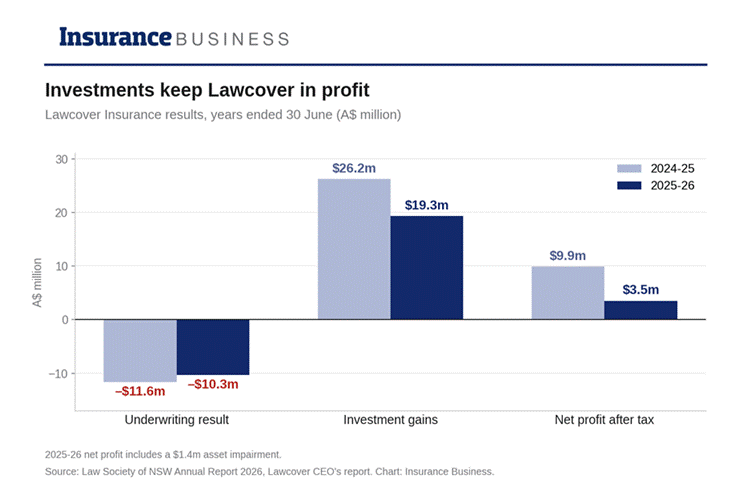
Chief executive Kerrie Lalich wrote in the report that Lawcover consistently budgets for an underwriting loss and relies on investment income to maintain its capital. She said more than 80% of premium ends up paid in claims, against an industry average of around 65% for PI. Lawcover also says independent actuarial analysis shows it has cut premium rates by more than 40% over 15 years, while industry-wide rates rose by more than 15%. It returned $5m of surplus capital through lower premiums in 2025-26 and has set aside a further $6m for 2026-27.
That approach is only possible because of the capital Lawcover built up in earlier years. Deloitte found Lawcover has run a combined ratio above 100% since 2020 and held four times APRA's capital requirement in 2019. The buffer is now smaller: 2.79 times the minimum at 30 June, down from 2.96 times a year earlier.
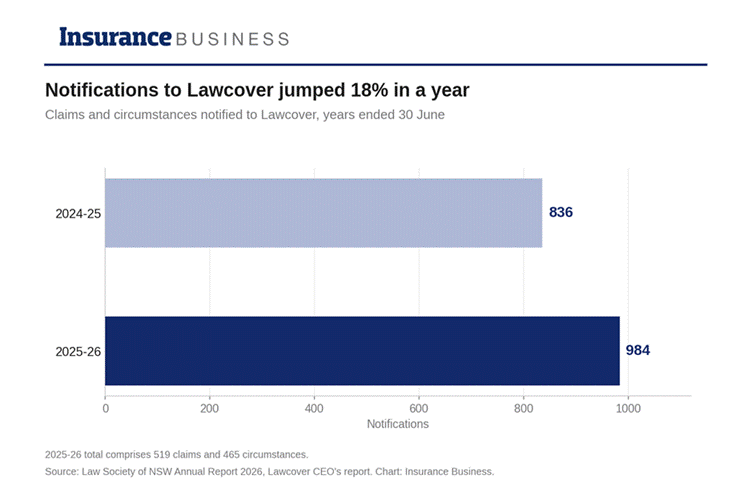
Claims activity is also rising. Lawcover received 984 notifications in 2025-26, up 18% on the previous year. Conveyancing and litigation together accounted for 61% of claims, and general commercial matters grew fastest.
Solicitors for PII Choice, the lobby group pushing for competition, appeared through lawyer Jacob Carswell-Doherty and suggested a middle path: open the market on a limited, trial basis. That idea has been around for decades. A 1999 NSW review recommended deregulation starting with a trial of up to three insurers, and Deloitte suggested capping the number of providers at first as one way to manage the risks.
For brokers, the fight is only over the compulsory $2m primary layer. Top-up and excess cover above it is already written on the open market. Opening the primary layer would change how solicitors' programs are built and placed, particularly for the thousands of sole practitioners who currently have no choice at all.
Read next: Gallagher highlights legal changes affecting professional indemnity for builders
The committee, chaired by independent MLC Taylor Martin, has not yet said when it will report. Until it does, and until the Attorney-General's approval power changes, ABC stays out and Lawcover's position holds.