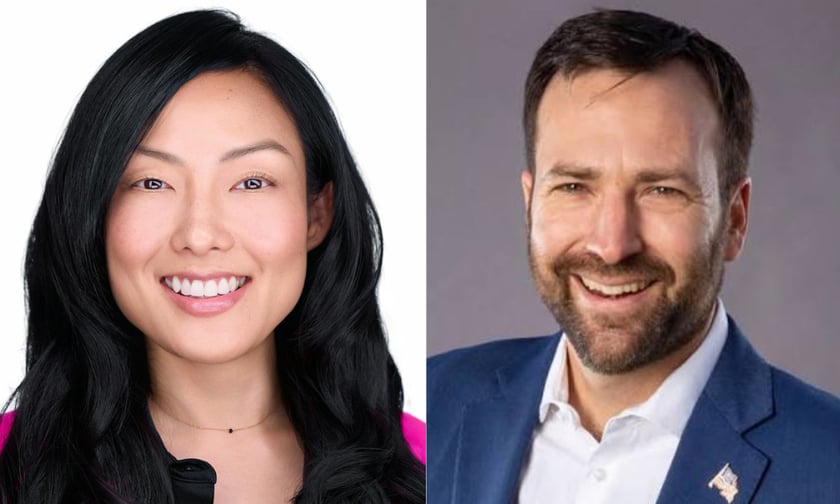
Attorney and political organizer Jane Kim (pictured, left) has emerged from California's primary election as the frontrunner to become the state's next insurance commissioner, setting up a November runoff against state Sen. Ben Allen (pictured, right) that could reshape regulation of the nation's largest insurance market.
With 95% of votes counted, Kim holds 27.2% of the vote compared with 19.3% for Allen. Under California's top-two primary system, both candidates advance to the November general election regardless of party. Insurance professional and Republican candidate Stacy Korsgaden finished third with 15.7%, according to an unofficial tally from the California Secretary of State.
The commissioner is responsible for regulating the nation's largest property insurance market, covering home and auto, health, pet, ride-hailing, life insurance and workers' compensation. Whoever wins in November will inherit a market in acute crisis.
FAIR Plan enrollment surged 43% between September 2024 and December 2025, following the January 2025 Los Angeles wildfires, which caused approximately $40 billion in insured losses and destroyed around 12,000 homes. As of June 2025, the FAIR Plan's total exposure had reached $650 billion, a 289% increase since the end of fiscal year 2019. In 46 of California's 58 counties, nonrenewals outnumbered new policies written in 2023, meaning the private homeowners insurance market contracted across most of the state.
The incoming commissioner will also inherit unresolved disputes with major carriers. In May 2026, outgoing commissioner Ricardo Lara's office sued to revoke State Farm's license, seeking what it described as the largest penalties pursued after a wildfire disaster this century, citing delayed and underpaid claims from the 2025 Palisades and Eaton fires. The department had by that point recovered more than $280 million from insurers for wildfire survivors, with total insured payouts exceeding $23.7 billion to residential, commercial and auto policyholders.
Under Lara's Sustainable Insurance Strategy, carriers have been permitted to use forward-looking catastrophe models in rate filings in exchange for commitments to write more policies in wildfire-distressed areas. Farmers Insurance has requested a near-7% rate rise and pledged to market to 300,000 consumers in high-risk zones from 2026, while Mercury General has targeted 15% growth in high-risk areas, with a commitment to shift 6.5% of FAIR Plan policyholders to its own coverage over eight years. California premiums are projected to rise 16% in 2026 as carriers implement the new risk-based pricing models.
Kim, a former San Francisco supervisor who later served as political director for Sen. Bernie Sanders' 2020 presidential campaign, is pitching structural reforms that go further than her predecessor's market stabilization approach.
Her headline proposal is a single-payer National Disaster Insurance for All program: a state-run risk pool funded through a levy on insurers, operating alongside the private market. Consumers would still purchase policies through private carriers, but the state would take a portion of the premium and invest it in resilience rather than distribute it as shareholder returns. Kim cited New Zealand as operating a comparable model and said the program would help depopulate the FAIR Plan by absorbing higher-risk properties.
"The current system is failing because it was not designed for modern climate catastrophes. It was designed for conditions 40 years ago," Kim said.
She is also proposing to expand California's Low Cost Auto Program into a broadly accessible public option and to create a public-facing dashboard showing how insurers spend premium dollars, covering investment exposures and claims processing speeds. On loss ratios, she is proposing minimums of 70% for auto insurers calculated over three years and 65% for homeowners, modeled on the medical loss ratio requirements that apply to health insurers.
Allen, whose own Senate district was directly impacted by the 2025 Los Angeles fires, was endorsed by both of California's US senators, Adam Schiff and Alex Padilla. He has called for greater transparency from insurers and the Department of Insurance, and supports banning commissioners from joining the insurance industry immediately after leaving office.
The next commissioner will also face an unresolved debate over the Proposition 103 intervenor process, under which consumer advocates can hire lawyers and actuaries to challenge rate filings. Lara's proposed reforms to that system drew opposition from 32 consumer groups, who argued the changes would undermine one of the most effective consumer protections in the state's rate-setting framework.
Kim is leading Allen by 11 points in his own Senate district of Los Angeles. "People want someone to take on the status quo that is making life more expensive and put forward some ambitious ideas for an economy that works for everyone," she said.
With the FAIR Plan under legislative scrutiny, State Farm facing potential license revocation and California premiums set to rise 16% in 2026, the November election will determine who steers the nation's largest insurance market through its most consequential period in decades.