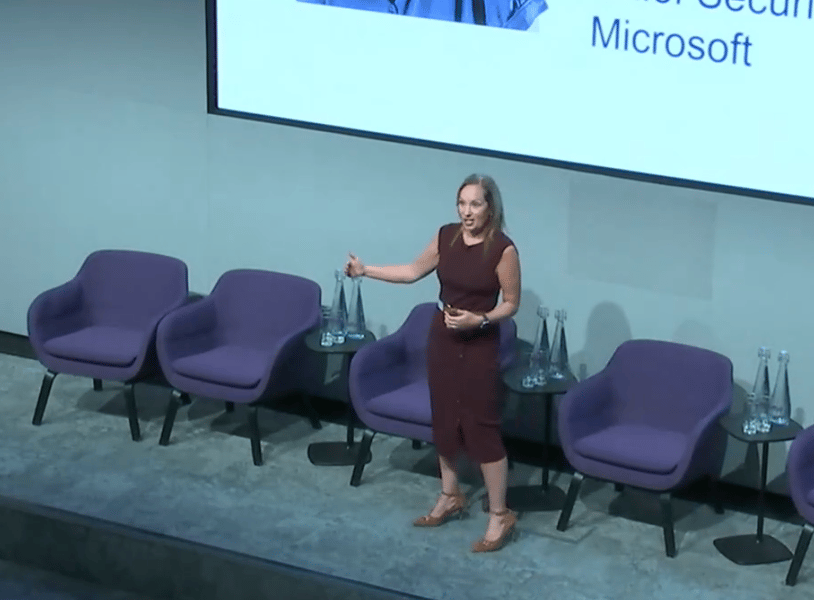
Image from Dive In Festival
Insurance firms racing to automate workflows face another risk alongside accuracy, bias and cybersecurity: employees simply disengaging from the transformation.
That warning opened Dive In Festival 2026 on Tuesday, as Sarah Armstrong-Smith (pictured), executive director at Secure Horizons and former chief security advisor at Microsoft, argued that the speed of artificial intelligence adoption is forcing companies to confront the human consequences of technological change much faster than in previous industrial shifts.
“We had the first industrial revolution, followed very quickly by the second industrial revolution. But that was multiple decades for us to get used to a different way of working,” said Armstrong-Smith. “The real difference is speed. The speed of change is at a rate we have never experienced before.”
Brokers and agents are under growing pressure to use AI to accelerate quoting, customer service, marketing and administrative work while preserving the advice and relationships that distinguish the intermediary channel.
A September survey commissioned by the Independent Insurance Agents & Brokers of America found 61% of consumers were more likely to choose an agent using AI and other modern technology to deliver faster, more personalized service. At the same time, 87% said having a human agent remained important when making insurance decisions.
However, adoption across the agency channel is still uneven. First Connect’s 2026 survey of 238 independent agents found only 35% were using AI in day-to-day operations, despite 53% expressing optimism about its impact. The same survey found 77% of agents were seeing increased client expectations around quote and binding speed.
Armstrong-Smith described the tension between the pressure to adopt new technology quickly and the operational and cultural risks of moving faster than employees were ready for. “You have these frontier AI companies setting (the pace) for everybody. Then you have the laggards sitting behind saying, ‘I’m not sure. I want to take my time,’” she said.
“If I’m too far behind, I no longer have competitive advantage. But if I’m too far ahead, I risk having real challenges in my organization with how this AI is going to be utilized. I have to sit in the middle and understand what’s going on at both ends.”
Employees worried that automation is being introduced to replace them may become less willing to contribute their knowledge to AI projects, test new systems or help redesign workflows. Armstrong-Smith described that response as one of the most significant organizational dangers created by poorly managed AI adoption.
“The most dangerous thing that happens to our organization is not AI. It’s apathy, because people stop caring,” she said. “They think, ‘I’m worried about my job. I’m worried about my livelihood. I’m worried about my children. I’m worried about the world they’re inheriting and what that means.’”
Armstrong-Smith also argued that accountability cannot disappear simply because more decisions are supported or executed by AI. Humans still determine where the technology is deployed, how much authority it receives and how its outputs affect other people.
“The human is always in that value chain,” she said. “It’s the human who decides at the beginning how we’re going to use AI and to what degree, and it’s a human who is impacted at the end as a result of that decision.”
Worker disengagement could become particularly consequential inside brokerages, where much of the value in client servicing and placement still sits in employees’ accumulated market knowledge, insurer relationships and understanding of individual accounts.
Gabby Joyner, head of WTW's employee experience business for Europe, told the opening session that human judgment and relationships would remain central even as technology takes a greater role in insurance work.
“Our role is to help clients navigate an increasingly complex world, respond to emerging risks and plan for their future,” Joyner said. “Human judgment, connection and collaboration will remain absolutely critical to that success.”
Dive In 2026 marks the 12th and final edition of the insurance industry’s global festival focused on diversity, inclusion, culture and talent. Since its launch, the event has brought together nearly 200,000 people worldwide and helped drive discussion around workplace culture, leadership and inclusion across the sector.
This year’s theme, “The Human gAIn: Powering Culture and Connection,” centers on how insurance organizations can navigate AI adoption while preserving the human judgment, trust and connection underpinning the industry.